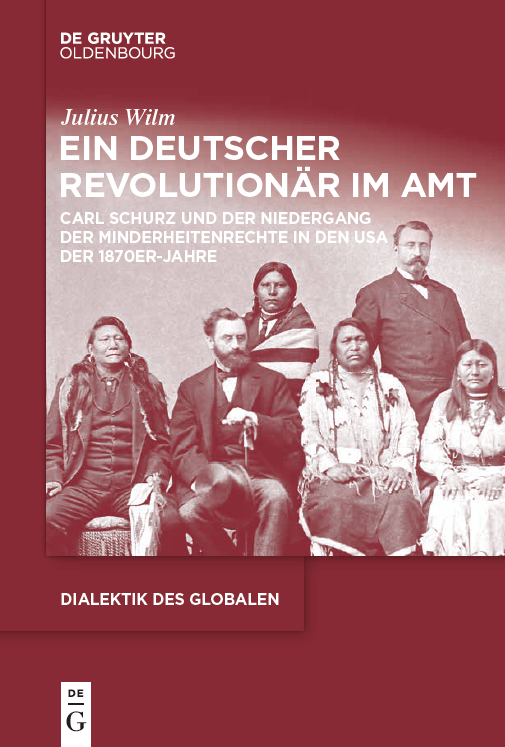
Julius Wilm, Ein deutscher Revolutionär im Amt: Carl Schurz und der Niedergang der Minderheitenrechte in den USA der 1870er-Jahre (Berlin, De Gruyter, 2024) 78 pages, 9 illustrations.
ISBN: 9783111430829
24,95 Euro
Now available as open access PDF via Deutsche Nationalbibliothek!
Der deutsche 1848er-Revolutionär Carl Schurz (1829–1906), der als Sklavereigegner und republikanischer Politiker in den USA der Bürgerkriegszeit Karriere machte, wird bis heute gefeiert als Verfechter der Gleichheit aller Menschen. Dieses Buch zeichnet anhand vieler bislang unbekannter Quellen ein differenzierteres Bild seines späteren politischen Wirkens. Als US-Senator opponierte Schurz seit 1870 gegen den Bürgerrechtsschutz für ehemals versklavte Afroamerikaner in den Südstaaten. Ab 1877 initiierte er als US-Innenminister eine harte Zwangsassimilationspolitik gegen indigene Gemeinwesen. Das Buch folgt Schurz’ Abkehr vom Universalismus früherer Jahre und stellt seine Vorschläge in den Kontext der kontroversen demokratiepolitischen Debatten der 1870er-Jahre. Obgleich sie offizielle Politiken späterer Jahrzehnte vorwegnahmen, trafen Schurz’ Bestrebungen, die Rechte von Afroamerikanern und Indigenen zu reduzieren, noch auf breiten Widerstand.
“Ein deutscher Revolutionär im Amt will Mythen korrigieren und auch die Diskussion um das deutsche Schurz-Gedenken mit Fakten versorgen.” – Frauke Steffens, “Schatten auf der Lichtgestalt”, Frankfurter Allgemeine Zeitung, 5. August 2024
“Wilm gelingt eine präzise Rekonstruktion von Schurzʼ politischer und intellektueller Biografie in den zwei Jahrzehnten nach dem Ende des Bürgerkriegs. Wer mehr über die Limitationen liberaler weißer Freiheitsideale in einem Jahrhundert der Nationsbildungen und imperialen Landnahmen erfahren möchte, sollte unbedingt zugreifen.” – Mischa Honeck, H-Soz-Kult, 3. September 2024
“Im Geschichtsunterricht könnte anhand der Causa Schurz eine sonderliche ‘Demokratiegeschichte auf beiden Seiten des Atlantiks’ (Hedwig Richter) mit Gewinn erörtert werden.” – Malte Ristau, Geschichte für heute. Zeitschrift für historisch-politische Bildung, Nr. 1 2025, S. 128.

Julius Wilm, Settlers as Conquerors: Free Land Policy in Antebellum America (Stuttgart, Germany, Franz Steiner Verlag, 2018) 284 pages, 39 illustrations, 23 tables
ISBN: 9783515121316 | €52 | ca. $57
Winner of the University of Cologne’s 2020 Offermann-Hergarten Prize
Preview:
Table of Contents | Introduction
Available from U.S. and international booksellers and many academic libraries
publisher | amazon | barnes&noble | worldcat
In early America, the notion that settlers ought to receive undeveloped land for free was enormously popular among the rural poor and social reformers. However, well into the Jacksonian era, Congress considered the demand fiscally and economically irresponsible. Increasingly, this led proponents to cast the idea as a military matter: land grantees would supplant troops in the efforts to take the continent over from Native nations and rival colonial powers. Settlers as Conquerors examines the free land debates of the 1790s to 1850s and reconstructs the settlement experiences under the donation laws for Florida (1842) and the Oregon Territory (1850).
Both laws promised to bring the interests of poorer whites and their government into a more harmonious relation – to the exclusion of African Americans and for the explicit purpose of displacing Native peoples. Drawing on new records, Settlers as Conquerors details the trajectory of settlements and shows how the settler-imperialist experiments fell apart and undermined the rationale of the donation laws. After home seekers fled Florida due to malaria and militias in Oregon triggered uncontrollable violence, settlers came to be seen as unreliable agents of government aims.
Praise for “Settlers as Conquerors”:
“This is the single most detailed exploration of free land in antebellum America.” — Amy S. Greenberg, Pennsylvania State University
“This is a skillful study of American proposals for the distribution of free public lands that predated the Homestead Act of 1862.” — Christopher Clark, University of Connecticut
“Wilm’s sensitivity to the effect of U.S. settlement policies on native peoples is one of the finest features of this book, furnishing a dimension that traditional U.S. land policy studies have lacked.” — John R. Van Atta, American Historical Review, Vol. 125, June 2020
“Settlers as Conquerors is critical to understanding the policies that preceded the Homestead Act and to understanding the history of Oregon. With its clear and engrossing narrative, this book deserves a wide readership.” — Katrine Barber, Oregon Historical Quarterly, Vol. 123, No. 4, Winter 2022
“… Wilm’s book is an excellent and detailed addition to the history of public lands and deserves a place on the bookshelf of anyone interested in the issue.” — Jamie L. Bronstein, Pacific Northwest Quarterly, Vol. 110, No. 3, Summer 2019
“Das Buch bringt wohlbekannte Fakten und neue Ansätze bezüglich Siedlungskonflikten in der frühen US-Republik in einen neuen Zusammenhang.” — Katharina Loeber, Zeitschrift für Historische Forschung, Vol. 49, No. 1, 2022
“This book is a model of careful scholarship. It has a tight focus but wide resonance, and it lays out evidence in logical detail. It also exemplifies the value of a fresh look: as a German scholar, Wilm clearly saw how this topic had drifted into the realm of mythology for U.S. historians.” — J. M. Opal, Western Historical Quarterly 51, Spring 2020
“The essential strength of the book lies in the author´s impressive research and data-driven evidence.” — Thomas Richards Jr., Journal of Southern History, Vol. 86, February 2020
“[a] captivating piece of research” — Hanno Scheerer, H-Soz-Kult, June 24, 2019
“extremely valuable comparative history” — Laurel Clark Shire, Missouri Historical Review, Vol. 114, No. 2, 2020
“The book […] would be quite suitable as content for a graduate level course or seminar on U.S. historical geography.“ — Michael Yoder, Journal of Historical Geography, vol. 66, October 2019
Contact me, if you would like to get access to an electronic copy of parts of the book.
 Julius Wilm